
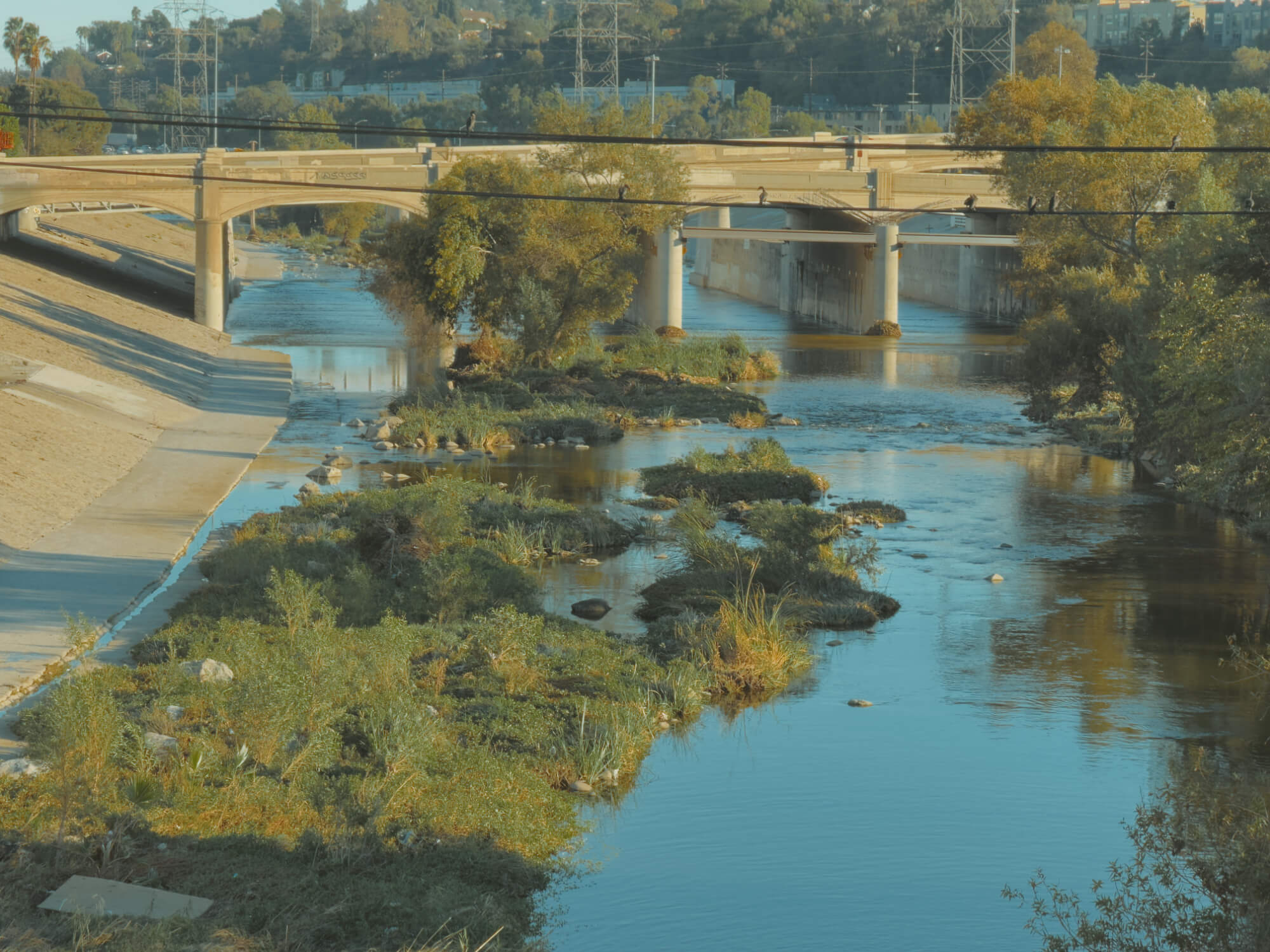
In August 1769, a small but intrepid band of Spanish explorers encamped in the L.A. basin not far from present-day Elysian Park. Led by the Spanish Governor of the Californias Gaspar de Portolá, and accompanied by Franciscan missionary Juan Crespi, the expedition’s priest-diarist, the contingent surveyed the vast California wilderness between Mission San Diego and the San Francisco Bay. Their long trek yielded many discoveries, but apparently few as impressive as the scene they encountered here. Padre Crespi's journal reads:
"[W]e entered a very spacious valley, well grown with cottonwoods and alders, among which ran a beautiful river....which we named Porciúncula."
Just a few days earlier, the expedition had celebrated the Catholic feast of Our Lady of the Angels of the Porciúncula. The holy day commemorated an Italian chapel on a small portion of land (porciúncula) dedicated to the Virgin Mary and granted to St. Francis Assisi around 1210. Following custom, the expedition named the river after the feast. And despite several earthquakes that jolted the party during its stopover, Crespi enthused that the locale offered a pleasant climate and “all the requisites for a large settlement.”
The rivercourse must have been idyllic. According to historians Leonard and Dale Pitt:
"The waters originated in the San Gabriel and Santa Monica Mountains and converged near what is today Elysian Park, spilling out from there onto the floodplain. Rather than flowing all the way to the ocean, the river sank into the soil, creating the numerous lakes, ponds, and marshes of [a] vast wetland... When, periodically, the water gathered enough volume, it flowed westward into Ballona Creek and emptied into Santa Monica Bay…"
Truth be told, Crespí wasn’t the first to envision a settlement here. The Indigenous Tongva people had beaten him to it centuries earlier, establishing a village called Yaangna just south of where the Portolá party encamped. (The expedition could see the smoke of the village's fires.) Still, thanks to the padre’s glowing report, El Pueblo de la Reina de los Ángeles—the Town of the Queen of the Angels—was founded 12 years later in roughly the same vicinity.
From the beginning, Los Angeles' fate was closely tied to its namesake river. After receiving their plots of land, one of the pobladores’ (townspeople's) first priorities was digging a Zanja Madre (Mother Ditch) from the watercourse to irrigate their arid pueblo. Today, that zanja's path through Olvera Street is marked in brick. An unearthed zanja conduit is also visible at the Los Angeles State Historic Park on N. Spring Street.
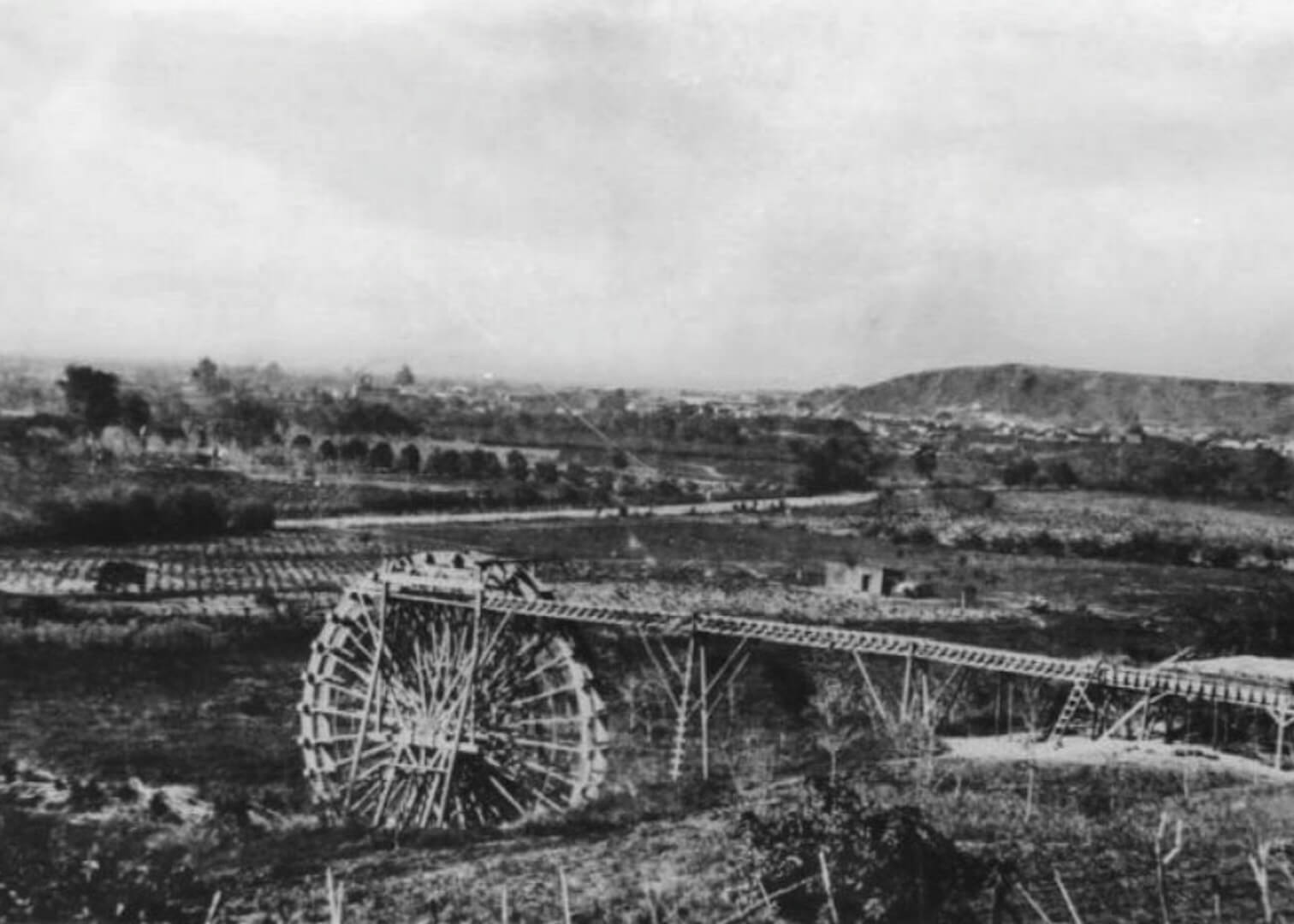
The Zanja Madre continued to quench the increasingly thirsty town into the American Era. By the 1860s, Angelenos had built a large wooden water wheel near present-day Solano Street. The wheel lifted river water to a flume that conveyed it to a reservoir, which in turn fed the zanja system.
A River Run Wild
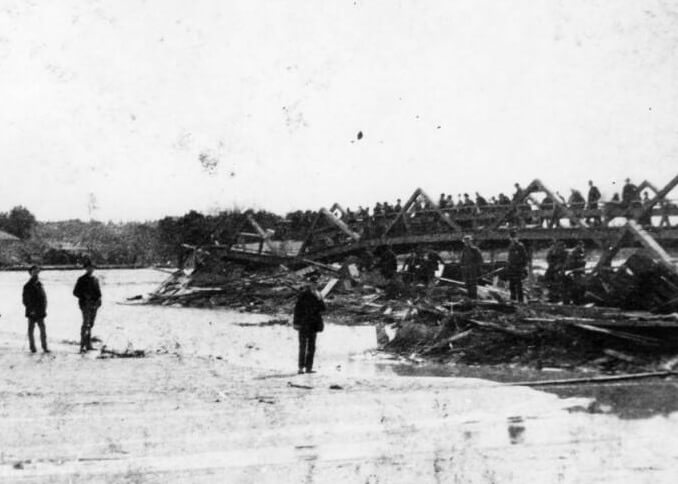
But throughout recorded history, Crespi’s “beautiful river” also had an ugly side. In 1825, massive flooding redirected the Porciúncula’s course southward toward Long Beach, away from the Ballona Creek estuary. After devastating floods in 1833 and the winter of 1861–62, the river again wreaked havoc in 1884 and 1886.
In his 1935 book, The City That Grew, L.A. pioneer Boyle Workman recalled the horrors he witnessed as a teen during the latter deluges:
“Houses, torn from their foundations, floated downstream with the smoke still escaping from their chimneys. Horses, cows, sheep and now and then the ghastly form of a human being, were part of the strange driftwood. Sometimes the water came in waves of 15 feet in height… The river became a boiling yellow lake.”
After enduring yet more catastrophes in 1889, 1914 and 1934, Angelenos decided they’d had enough of Padre Crespi’s beautiful river. The U.S. Army Corps of Engineers undertook an enormous flood-control project, accelerated by yet another disastrous deluge in 1938. By 1959, reinforced concrete confined almost the entire waterway, effectively turning it into a 51-mile storm drain.
Respecting Nature
Because we're accustomed to a tamer Porciúncula, we easily forget the river’s destructive power. But every now and then, we get some reminders.
Take, for instance, El Niño seasons, when residents (especially more recent arrivals) routinely express shock at “unprecedented” heavy rains and flooding—even though none of it is really all that “unprecedented.”
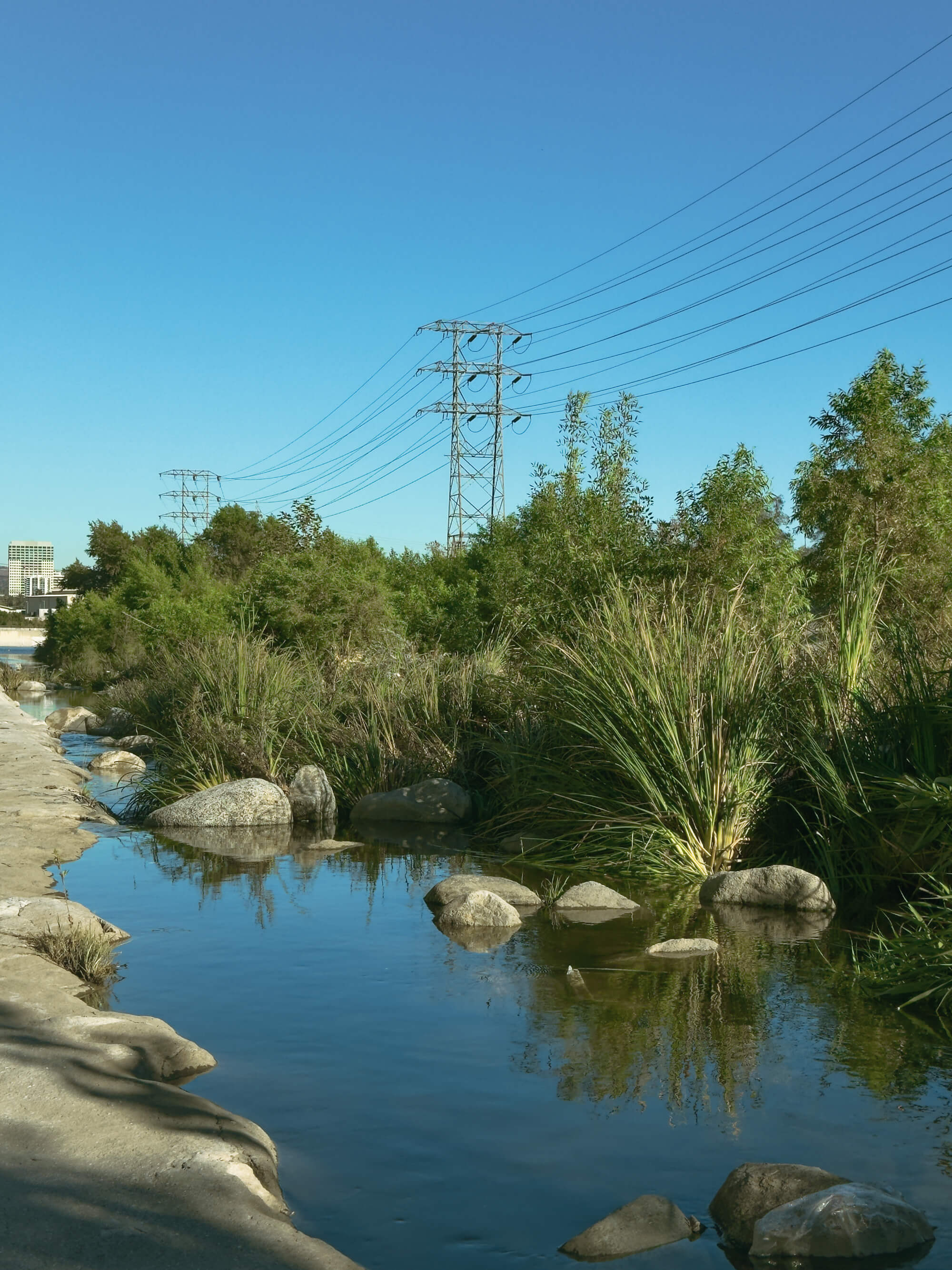
Today, despite repeated environmentalist calls to heal the riverbed, only a few stretches hint at its once-natural state. One is the popular 7-8-mile Glendale Narrows near Griffith Park. Visiting any of the several pocket green spaces lining the Narrows can be rejuvenating. Atop the banks, determined cyclists whisk along bike paths, while below, the bed teems with waterfowl and other flora and fauna. Here and there, joggers and urban adventurers traverse riverside pathways.
Visiting these spaces after more than two centuries of ebbs, flows, floods and disfiguring concrete, it's still easy to see how the Porciúncula so deeply moved Padre Crespi when he first encountered it.
Sources: The Los Angeles River Web Exhibit (accessed 2007); Los Angeles: From Pueblo to City of the Future, Arthur Saul et. al., 1976; Los Angeles A-Z, Leonard Pitt and Dale Pitt, 2000 Edition; The City That Grew, Boyle Workman, 1935.